

Commentaries | Mar 14,2026



May 16 , 2026
By Ralph Regenvanu
Billions of people are currently facing, or are projected to face, rising sea levels, intensifying storms, floods and deadly wildfires. A UN resolution, shaped by input from nearly every UN member state, reflects a broad appetite for a global response despite geopolitical friction. In this commentary provided by Project Syndicate (PS), Ralph Regenvanu, Vanuatu's Minister of Climate Change, warned that failure to act on the ICJ’s legal findings would con-cede that vested interests have the power to derail progress toward collective survival.
Last year, the International Court of Justice (ICJ) delivered a legal opinion on climate change with a clarity of purpose not seen since the 2015 Paris agreement. It left no doubt that states have a legal obligation to prevent "significant harm" to the climate system, and that failure to do so carries legal consequences.
My own country, Vanuatu, brought this question to the world and to the ICJ. But we were not alone. We built a coalition of countries spanning every region and gained sustained support from youth movements. Ultimately, 132 countries co-sponsored a motion for a United Nations (UN) resolution asking that the ICJ rule on the matter, which then passed by consensus. It was a historic moment, and one that did not happen by accident.
Now we are back at the UN General Assembly, presenting a resolution to give the ICJ's advisory opinion practical effect and calling on the world to support it. It is normal practice for ICJ advisory opinions to be returned to the UN General Assembly, where resolutions give member states an opportunity to amplify the political and normative authority of such rulings. This new resolution not only calls on the UN to endorse the opinion but also urges all member states to uphold the obligations identified by the Court. It sets the stage for follow-up action within the UN system, such as a formal request to the Secretary-General to find ways to advance compliance.
We believe this new resolution is the best way to ensure that legal obligations to deal with climate change do not simply sit on a shelf. They must be reflected in the real world, even if certain states would rather pretend that the ruling did not happen.
We are under no illusions that the ICJ's ruling will be difficult for some countries to implement. But we cannot ignore the costs of inaction. This is a critical moment, not only for the climate but also for the future of international cooperation. The entire postwar, post-colonial multilateral order is under considerable pressure. Large states are withdrawing from international agreements and withholding funding from multilateral organisations. Bilateral deals are replacing collective frameworks. Many fear that the global architecture of rules, norms, courts, and international accountability is crumbling before our eyes.
In this context, reaffirming the role of institutions like the ICJ would be a shot in the arm for multilateralism. What Vanuatu, a country of only around 340,000 people, has accomplished shows that the system can still function. We took a legal question to the appropriate institution, and that institution did its job. The process was slow, and we faced plenty of resistance along the way. But justice prevailed. All states had a chance to argue before the Court, whether they were for or against the motion, and the outcome was clear.
The ruling gave vulnerable people around the world hope and lent new momentum to multilateral climate action, especially the UN Framework Convention on Climate Change, the process that has organised the international response to climate change for more than 30 years. Everyone participating in the annual UN Climate Change Conferences (COPs) now knows where the world court stands. The obligation to cooperate on meaningful solutions is not merely political and moral, but legal.
Following weeks of negotiations, our new resolution has been shaped by input from almost every UN member state and facilitated by a core group of countries from every region of the world. That breadth of engagement is no accident. It shows that the appetite for a truly global response to climate change remains strong, even at this fraught geopolitical moment.
There is no defensible reason for states to vote against the resolution. If we fail here, we will be signalling to current and future generations that we have moved from a system built on cooperation to one governed by power alone. We will be conceding that pressure from vested interests can derail the progress we have made toward guaranteeing our collective survival.
It is no secret that powerful vested interests want to delay the transition away from fossil fuels. Despite the rapidly falling costs of renewables, they have no problem leveraging their money and influence to frustrate efforts to mitigate climate change. Small island states like Vanuatu are particularly vulnerable to these bad-faith actors.
Still, the world is now witnessing the consequences of relying on a fossil-fuel economy. While Vanuatu has long been vulnerable to increasing climate-related risks such as cyclones and drought, we are currently experiencing a different kind of storm. Those fueling up at gas stations in Port Vila are seeing the same high prices as hundreds of millions of others around the world. We are all learning the hard way what a failure to phase out fossil fuels looks like.
The conflict in the Middle East reminds us that fossil fuels do not only heat the planet. They also inflame conflicts. The sooner all of us move away from such volatility, the better.
We all have a duty to keep fighting for international cooperation, because the alternative, a world that stops trying to solve its hardest problems collectively, would be worse than the current one. Vanuatu and its many like-minded partners will continue to push forward, not only on behalf of our own communities but on behalf of others, too. Billions of people are already facing, or will soon face, rising seas, intensifying storms, deadly wildfires, and the relentless erosion of everything we have built.
The law has spoken. The question confronting every state is simple. We know the rule of law applies to climate change, but do you intend to act on it?
PUBLISHED ON
May 16,2026 [ VOL
27 , NO
1359]
Commentaries | Mar 14,2026
Fortune News | Sep 21,2025
Commentaries | Apr 10,2021

Viewpoints | Dec 02,2023

Fortune News | Jul 15,2023

Radar |
Editorial | Feb 27,2021
Commentaries | Apr 13,2024
Radar | Aug 28,2021
Commentaries | Apr 30,2022

Photo Gallery | 186413 Views | May 06,2019

Photo Gallery | 176462 Views | Apr 26,2019

Photo Gallery | 172288 Views | Oct 06,2021

My Opinion | 139721 Views | Aug 14,2021









Dec 22 , 2024 . By TIZITA SHEWAFERAW
Charged with transforming colossal state-owned enterprises into modern and competitiv...

Aug 18 , 2024 . By AKSAH ITALO
Although predictable Yonas Zerihun's job in the ride-hailing service is not immune to...

Jul 28 , 2024 . By TIZITA SHEWAFERAW
Unhabitual, perhaps too many, Samuel Gebreyohannes, 38, used to occasionally enjoy a couple of beers at breakfast. However, he recently swit...

Jul 13 , 2024 . By AKSAH ITALO
Investors who rely on tractors, trucks, and field vehicles for commuting, transporting commodities, and f...
May 16 , 2026
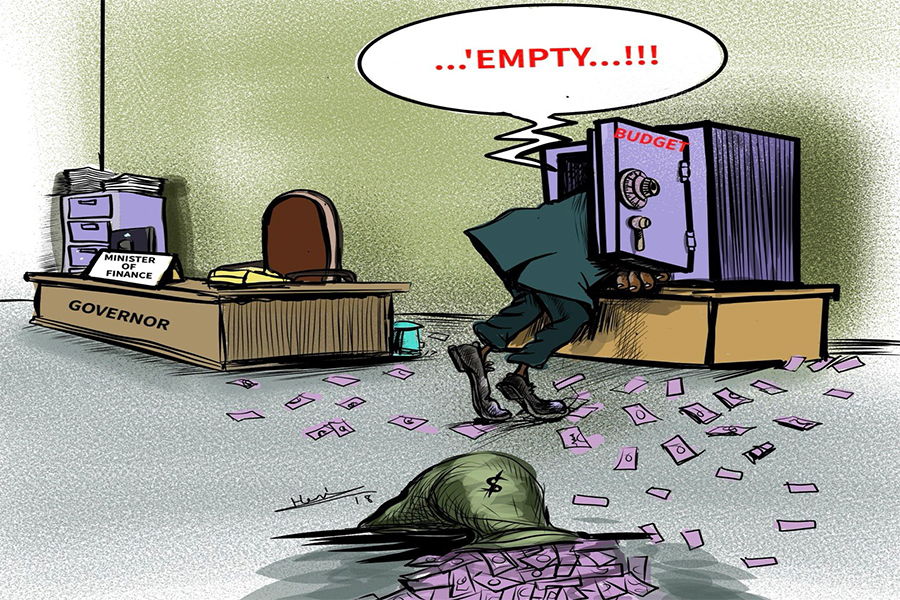
The federal budget tells a troubling story about inflation, debt and reform. The prob...

May 9 , 2026
The Ethiopian state appears to have discovered a fiscal instrument that is politicall...
May 2 , 2026
By the time Ethiopia's National Dialogue Commission (ENDC) reached the end of its fir...
Apr 25 , 2026
In a political community, official speeches show what governments want their citizens...
May 17 , 2026 . By NAHOM AYELE
A revised tax administration law could bar taxpayers from submitting new evidence dur...
May 17 , 2026 . By BEZAWIT HULUAGER
The federal government's plan to build a capital market begins where the financial sy...

May 17 , 2026 . By DAGIM SEIFE
The federal agency in charge of imports and distribution of medicines launched “Pro...
May 17 , 2026 . By NAHOM AYELE
The Federal Supreme Court's interim order late last week has turned a technical tax d...






 Loading your updates...